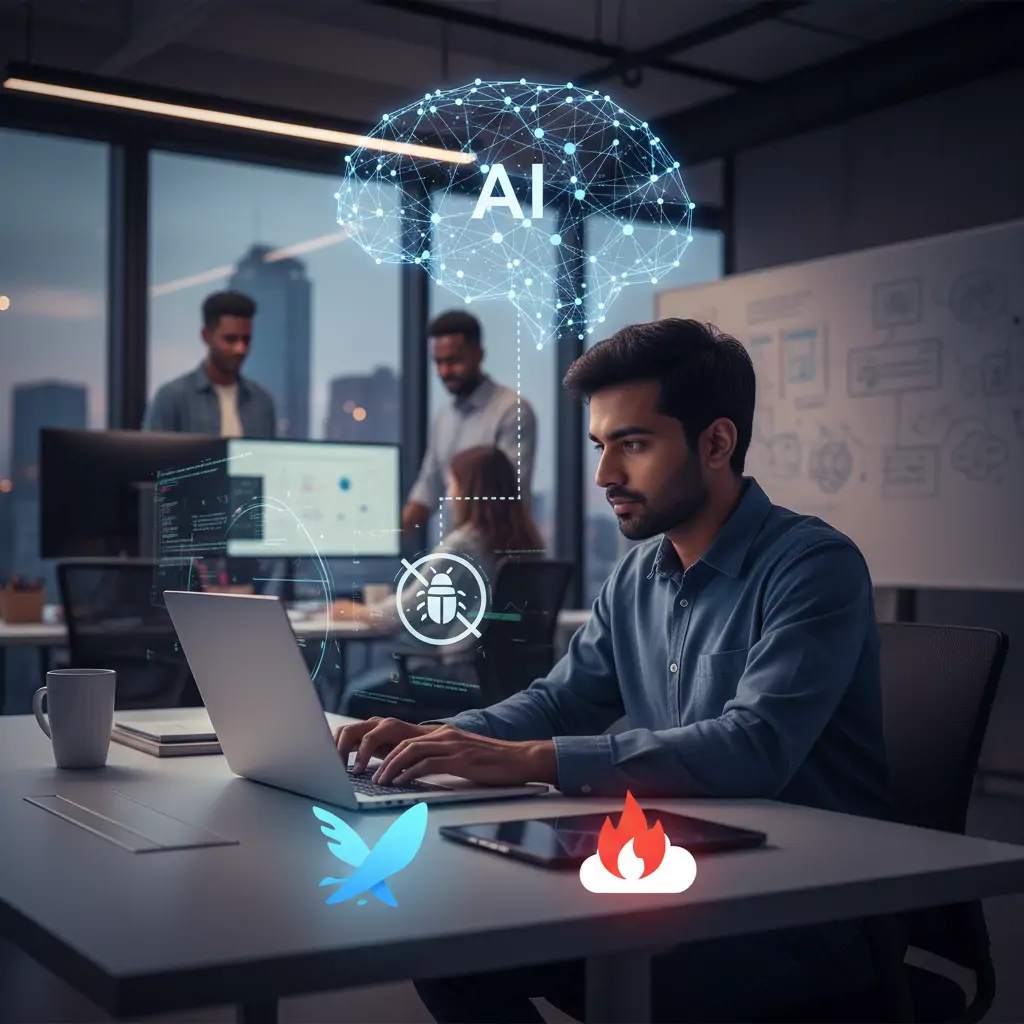
Introduction: Why This Matters Now
In 2025, the tech industry is witnessing a seismic shift as AI-powered autonomous agents emerge as a transformative force in software development. Recent data from Gartner highlights a 60% reduction in development time for software projects utilizing AI agents, underscoring the disruption of traditional coding practices. This trend signifies a pivotal moment for developers, businesses, and investors, fundamentally altering how applications are built and deployed. Read time estimate: 12 minutes.
The Current State: What's Happening Right Now
As of 2024, major tech companies like Google, Amazon, and Microsoft are integrating autonomous agents into their development workflows. In March 2025, Microsoft reported a 50% increase in development efficiency using its AI toolset, CoPilot X. Meanwhile, startup CodexAI, launched in January 2025, secured $120 million in funding, aiming to democratize AI-assisted coding for small businesses. The global market for AI in software development is projected to reach $45 billion by the end of 2025, driven by these advancements. Traditional manual coding approaches are struggling to keep pace with the demands for speed and efficiency, as evidenced by a 35% decline in demand for traditional coding roles in Q1 2025.
Key Drivers: What's Fueling This Trend
Driver 1: Economic Efficiency
AI agents significantly reduce development costs. A 2024 McKinsey report found that companies adopting AI in coding saw a 40% decrease in project costs due to reduced manpower needs and faster completion times.
Driver 2: Technical Advancements
The evolution of natural language processing (NLP) and machine learning models has enabled AI agents to understand and generate complex code structures. OpenAI's GPT-4, released in late 2024, achieved near-human-level coding capabilities, as noted in their annual report.
Driver 3: Market Demand for Agility
Businesses are under pressure to release products faster and iterate based on user feedback. AI agents empower teams to adapt swiftly, with Adobe reporting a 70% faster rollout of new features in its software suite in 2025.
Real-World Impact & Case Studies
Case Study 1: Google
- Integrated AI agents for bug detection
- Reduced bug resolution time from weeks to days
- Key lesson: AI enhances code quality and speeds issue resolution.
Case Study 2: CodexAI
- Enabled non-technical users to build functional apps
- Lowered entry barriers, fostering innovation
- Key lesson: AI democratizes development, empowering diverse creators.
Industry Implications
For Developers
- Skill up on AI toolsets and data analytics.
- Explore roles in AI integration and oversight.
For Businesses
- Leverage AI to outpace competitors with rapid iteration.
- Reduce operational costs through efficient resource allocation.
For Investors
- Invest in AI-driven startups to capitalize on market expansion.
- Evaluate risks in industries slow to adopt AI technologies.
Challenges & Criticisms
While AI agents offer numerous benefits, they also raise concerns about job displacement and the ethical use of AI. Critics argue the potential for bias in AI-generated code and emphasize the need for human oversight. Moreover, dependency on AI tools could lead to a skills gap where developers lack foundational coding knowledge.
Future Outlook: What's Next
In the next 6-12 months, expect more companies to adopt AI agents, spurring further innovation in development methodologies. Long-term, by 2027, AI agents could become standard in all software projects, influencing education systems to focus on AI literacy. Key milestones include the anticipated release of AI-enhanced IDEs by major tech firms, which will revolutionize how developers interact with code.
Frequently Asked Questions
- How will AI agents affect developer jobs? AI will shift roles towards AI oversight and integration, rather than traditional coding.
- Are AI agents reliable? Yes, with human oversight, they improve efficiency and reduce errors.
- What are the barriers to adoption? Initial setup costs and the need for new skill sets are primary challenges.
- How soon will AI agents become mainstream? By 2027, AI agents are expected to be standard in software development processes.
Conclusion: Key Takeaways
- AI agents are rapidly reshaping software development, offering faster, cost-effective solutions.
- Developers must adapt by learning AI and data analytics skills.
- Businesses can leverage AI to gain competitive advantages and reduce costs.
- Investors should keep an eye on AI-driven startups for future growth opportunities.
To learn more, explore our detailed guide on AI integration in development processes.